Sachem River
I Know This Much Is TrueThe Sachem River is a recurring landscape and organizing image in Three Rivers. Its course connects the grounds of Settle Hospital with the Indian cemetery and The Falls, drawing Thomas, Dessa, and Dominick to its banks at different points in their lives. The river is not merely a backdrop: its movement gives shape to scenes of family obligation, private grief, inherited violence, and the difficulty of making peace with the past.
Setting and route
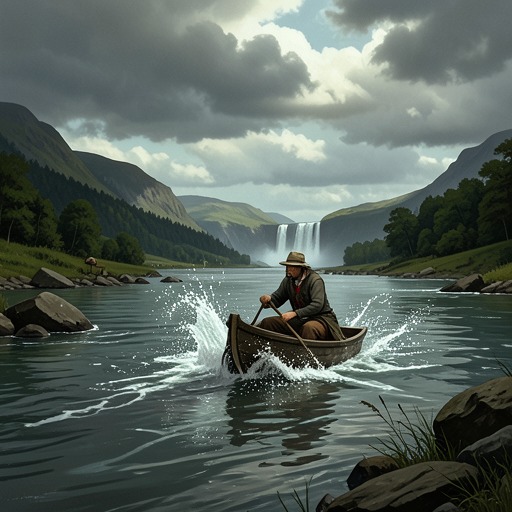
A path from the southern end of the Indian cemetery climbs through pines, pin oaks, and cedars, then passes through mountain laurel before reaching The Falls. The route follows the sound of water and crosses boulders; the river becomes visible again between rock cliffs, where it rushes through a gorge. The Falls is known by that simple name throughout Three Rivers, and its surrounding landscape is both accessible by foot and notably isolated. The cemetery, the riverbank, and the gorge form a connected geography rather than separate destinations: a visitor can move from the traces of buried lives to the river and then climb toward the Falls.
The river also borders Settle Hospital. When Thomas receives a grounds card, Dessa and Dominick collect him on Sunday afternoons at the entrance to the Settle Building. They walk past the hospital’s older brick buildings and the Ribicoff Research Center, cross the rear boundary, and descend to the Sachem River. Sometimes Thomas removes his shoes and socks and wades in the current; on other visits, the three continue along the bank to the small Indian cemetery. The walk gives Thomas supervised freedom beyond the hospital buildings, while its repeated route establishes a modest ritual of family contact.
Thomas, Dessa, and Dominick at the water
At the cemetery, Dessa and Dominick look at the gravestones while Thomas sits on the grass, smokes, and reads his Bible. By this period, Thomas has come to see himself as God’s right-hand man and a target of the KGB. He follows the others with interpretations of the Bible and predictions of disaster, drawing on the news and his dreams. Dominick’s visits become an obligation he wants to end quickly: he hurries ahead and returns Thomas to Settle, while Dessa urges patience. The river walk therefore holds two experiences at once—Thomas’s pleasure in the water and the strain of his brother’s effort to care for him.
The same landscape becomes a place of solitude for Dessa. She sometimes disappears for whole afternoons and returns in a daze, with leaves and burrs caught in her hair. Dominick follows her once, tracing her route past the river and Indian cemetery to The Falls, where she sits watching the water. Concerned by how isolated the location is, he buys pepper spray for her; she often leaves it at home. Her repeated return to the gorge makes the riverbank a private retreat at a time when she does not want Dominick’s company. The place offers no stated explanation for her grief, but its solitude gives that grief room to remain unspoken.
Dominick, too, goes to the river during the worst nights after Angela’s death. He drives there after speeding on the highway, parks near the hospital and cemetery, and once climbs the rock ledge at The Falls, recalling that he had climbed it with friends when he was young. He hopes the elevated view might help him understand ideas of divine will and mercy, but it does not resolve the loss of his infant daughter. The river and gorge thus recur as places he seeks when ordinary life feels unbearable, without offering him a simple answer or release.
A site of violence and inherited history
The Falls carries a local story that joins the landscape to violence. As Dominick recalls it, Chief Samuel pursued an enemy sachem to the cliff and forced him to choose between surrender and a dangerous leap to the opposite ledge. The enemy survived the jump but injured his leg; Samuel followed and ultimately killed him. The account comes to Dominick through his tenth-grade American history teacher, Mr. LoPresto, and is presented as a mixture of history and legend. The gorge is consequently marked not only as a scenic destination but also as a setting where power and survival are remembered through a story of pursuit.
The river’s bridge is the setting for another act of violence, this one carried out in the family history Dominick reads. After Filippa, a monkey, bites him, Domenico decides to kill her rather than keep his promise to his mother to care for the animal. He pays the boy Cavoli to bring a burlap sack weighted with discarded bricks to the Sachem River Bridge. Domenico and Cavoli force Filippa into the sack and throw it over the railing; it sinks. The account makes the river the instrument of an irreversible choice. Later, Dominick tells Dr. Patel that the episode unsettles him because he and Thomas resemble their ancestor. In this way, the river links family history to the present not by proving that the generations are identical, but by giving Dominick a concrete scene through which to consider what has been inherited.
The river as continuity
During a conversation with Dominick, Dr. Patel asks him to imagine directing the river to reverse its course, challenging his sense that he can control the direction of events. She then describes life as a river flowing from the past through the present toward the future. In her account, people are born not only at the moment of physical birth but also out of what came before them, through genetic and lived experience. Her metaphor gives the river a meaning that reaches beyond any single visit: family history continues into the present, even when its contents are painful.
Dominick later visits the Indian cemetery and stands at Henry Joseph Drinkwater’s grave, marked with his name and the dates 1919–1950. From there he hears the river at The Falls before continuing his search for the Wequonnoc Tribal Council office. The sequence places a family grave and the sound of the river beside his effort to find a larger history of kinship. Across the novel, the Sachem River remains materially the same route through Three Rivers, but what its banks hold changes—from supervised walks with Thomas, to Dessa’s solitude and Dominick’s bereavement, to the troubling acts recorded in an ancestor’s story. Its current becomes an image of continuity without consolation: the past flows onward, shaping the living, while the water itself does not turn back.